
Part 2. The 1990s: Operas and Optics
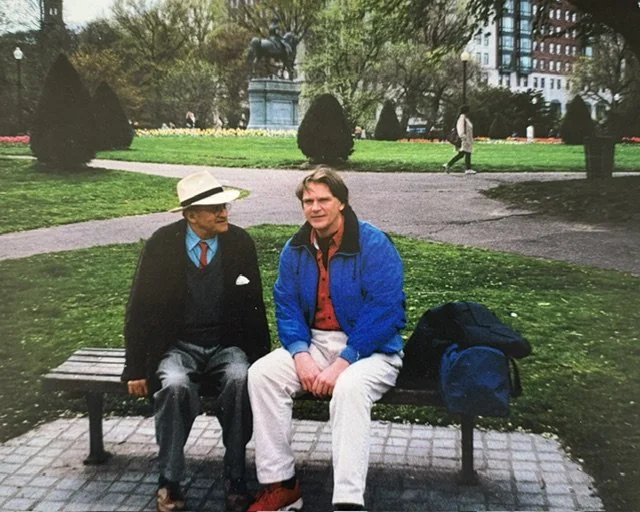
David and Bing, Boston Public Garden, April 1998.
HOCKNEY REPRODUCTION(S)
A Celebration of the Life and Art of David Hockney (1937–2026)
Manship Artists Residency
Gloucester Massachusetts
September 11 – October 18, 2026
Gallery Hours: Fridays, Saturdays, and Sundays, 1:00 – 5:00 PM
Supported by The David Hockney Foundation (UK) Limited
Hockney Reproduction is an exhibition opening in September at Manship Artists Residency. It has been decades in the making. This is the second in a series of essays by Bing McGilvray on the artwork of David Hockney, to be published in COSMOS over the coming months. Bing will elaborate on how each piece in the show represents a different phase in Hockney’s oeuvre. He will also discuss his long friendship with the renowned artist, which continues to this day.
© Bing McGilvray
May 13, 2026
OPERAS AND OPTICS
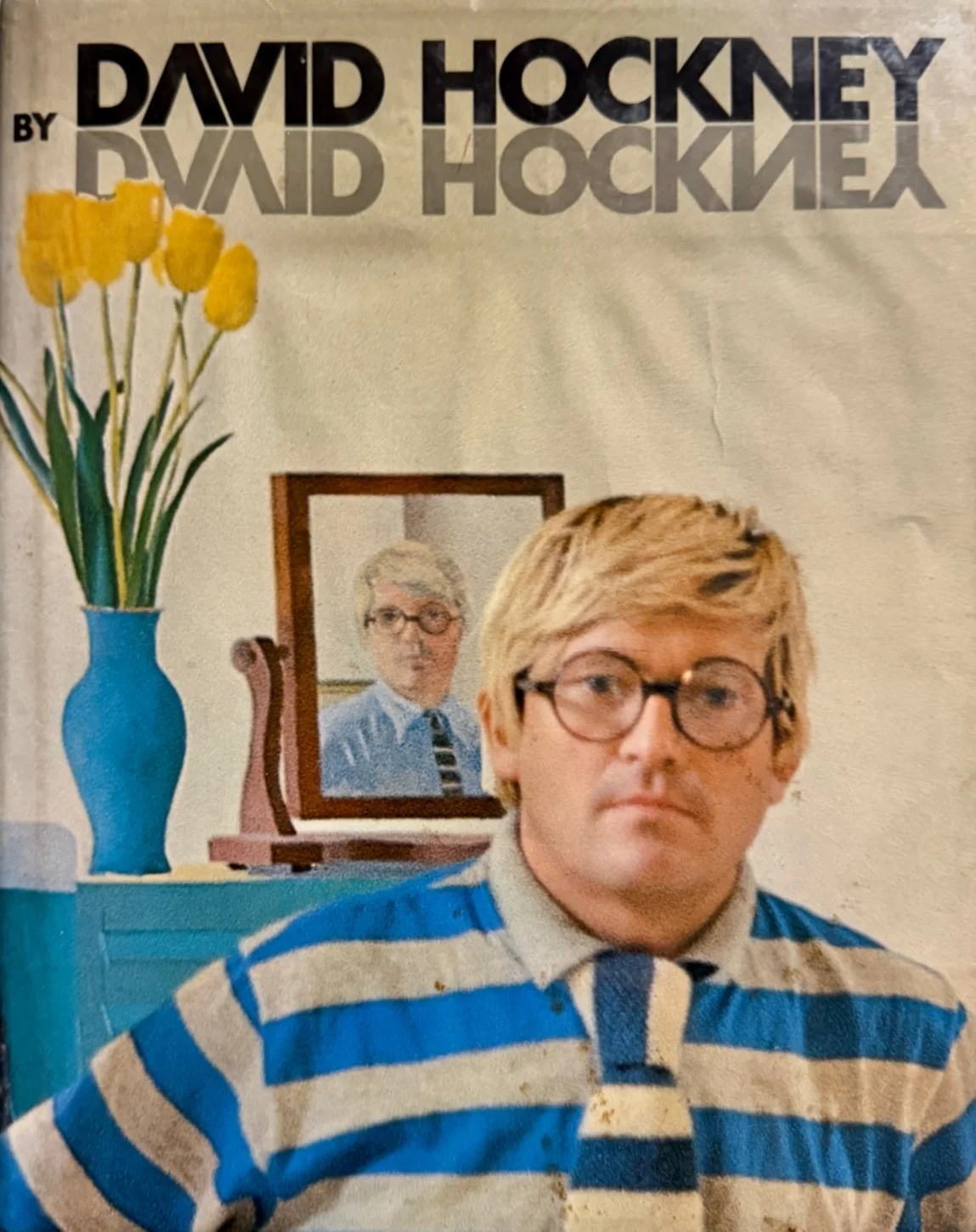
When it comes to reproduction, two seminal books provide a startling comparison. Released in October 1993, That’s the Way I See It was the sequel to David Hockney by David Hockney (1976). In both books, astutely edited from years of interviews by Nikos Stangos, we hear David expounding about his most recent work and how it relates to his ever-expanding theories about optics, perspective, technology, cameras, film, and art history. That’s the Way I See It begins with an 8-page treatise entitled “Reproducing and Representing”. The tone is conversational and the reader feels they are privy to a fascinating personal lecture. For me, rereading it now, I can hear David’s own voice repeating the same observations I have listened to so intently many times before.

Book cover, That’s the Way I See It, 1993. Cover photo © Jim McHugh
These two autobiographies were separated by only 17 years but the rapid advances in printing are evident. In David Hockney by David Hockney*, about half the images were printed in color. That’s the Way I See It is lavishly illustrated in glorious color, on almost every page. In less than 20 years, color reproduction had improved more than it had in the centuries since the first printing of Gutenberg’s Bible. David rode the waves of these tech tsunamis. His experiments with photography, copiers, digital cameras, fax machines, video, and early computer programs throughout the 80s are recapped in the text along with prescient observations about where technology may be taking us.
Seamlessly mixed in are David’s thoughts on representation and abstraction. As he often stated, “They are not separate. Each must contain the other.” The book provides proof of this in his paintings, prints, photo collages and most of all, his stage designs. The experimentation of the '80s blended into and influenced the opera sets. He worked out ideas in his paintings, or “narrative abstractions” as he called them. They filled the walls of his studio, which was also occupied by a towering, enormous scale model of the opera stage. Two operas dominated David’s life in the early '90s, Turandot and Die Frau ohne Schatten.
THE EYE OF THE STORM
In late 1989, David invited me back to LA to work on Giacomo Puccini’s Turandot, a co-production of the Lyric Opera of Chicago and the San Francisco Opera. Initially he signed on to design the sets but, after a disagreement with the director, he decided to direct himself. I moved into his two-bedroom guest house and thus began the most intense, exhilarating and for me overwhelming period of our friendship. I was a 24/7 employee.
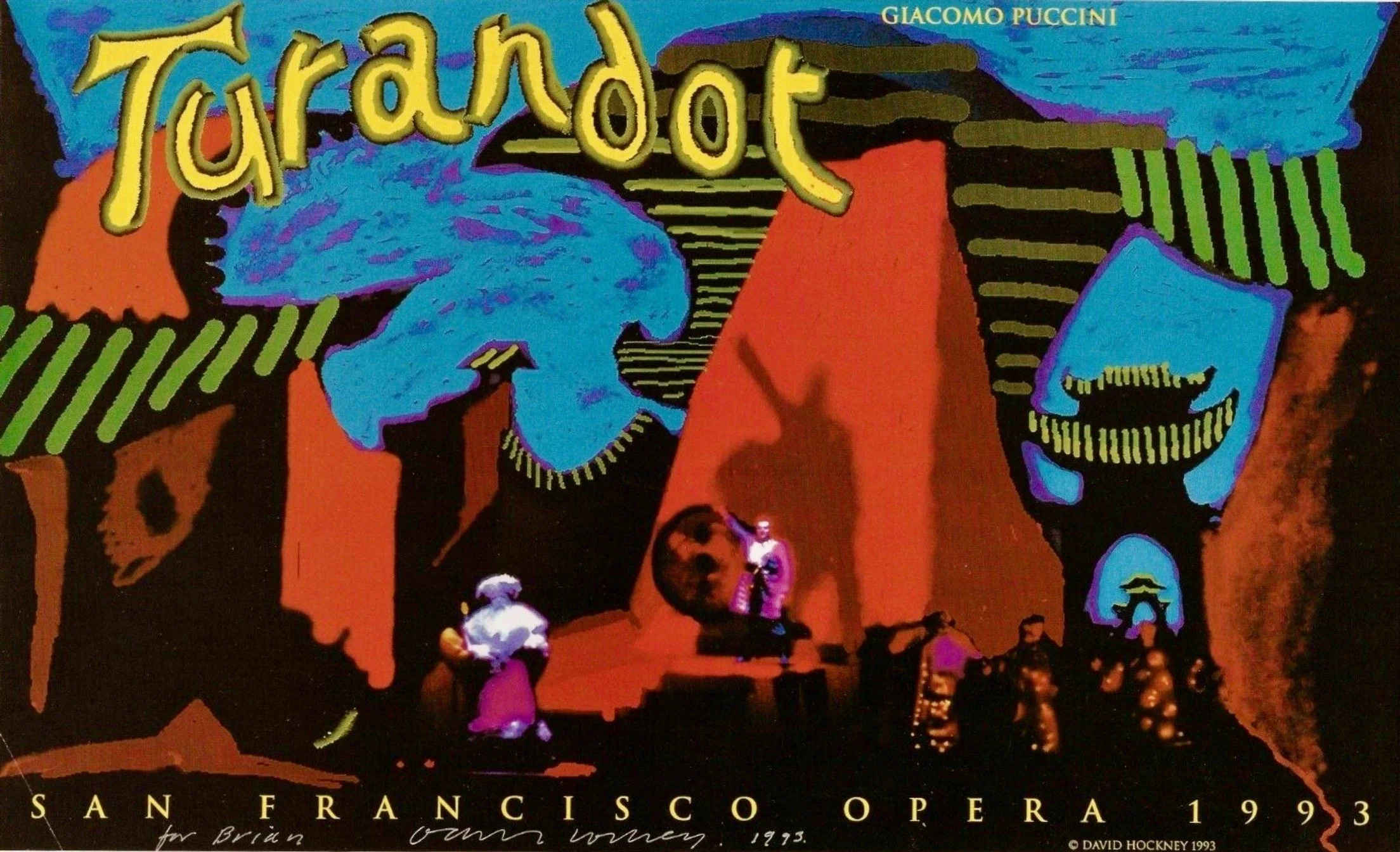
San Francisco Opera Turandot poster, 1993.
Every day the atmosphere in the studio was highly charged, a tempest of chaotic creativity. There was a constant stream of people coming and going - assistants, tech people, familiar friends, office staff, art dealers, journalists, celebrities, even a film crew making a documentary. I was wide eyed in the vortex.
Since I had focused on video production in my graduate work at UCLA Film School, I oversaw the use of 6 new Hi-8 video camcorders and a variety of playback/editing equipment. David and his assistant Richard Schmidt assembled a lighting board controlled by a system of “vari-lites,” another new compact tech advancement. We could record entire scenes and fine tune how the subtle changes would synchronize with the music. I would make an edited version from several viewpoints and David would watch them the following day.

Salts Mill poster image: The Other Side, 1993.
Lighting was key to this production. David was seeking a sensory synesthesia for the theater, making the eyes see the music and the ears hear the color. By slowly shifting the lighting between foreground, middle and background, dimming here and increasing there, projecting color onto color, playing with shadows, and spotlighting the players, the effect was sublime.
THE APPRENTICE
Hockney was now a great Hollywood director as well as the head of the studio. Many people, too numerous to mention, formed the core of his production team. Most importantly was Ian Falconer, a brilliant and versatile artist whose costume designs were witty, wonderful, lavish, and the perfect complement to David’s colorful stage creations.
After the operas were finished, Ian moved to NYC. Soon he began drawing covers for The New Yorker, but younger readers will recognize him as creator of the Olivia children’s books. Ian also continued in the theater, a world he loved. He worked with David Sedaris on The Santaland Diaries and created sets and costumes for ballets choreographed by Christopher Wheeldon and Peter Martins. Falconer’s masterpiece was his enchanting The Nutcracker designed for The Pacific Northwest Ballet in 2015. Opening night in Seattle was a sheer delight. Ian passed away in 2023. He was a dear friend, gone too soon.
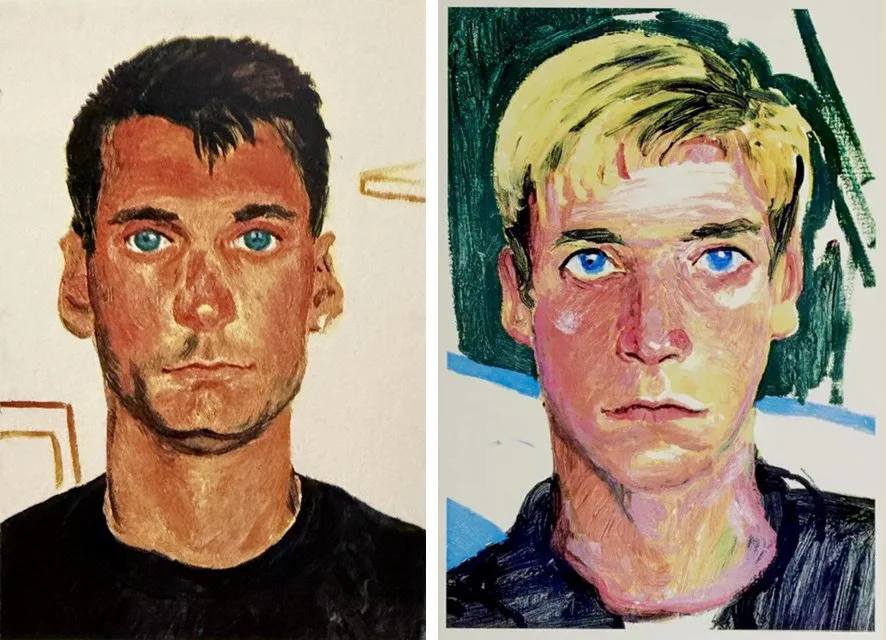
Portrait of Richard Schmidt, 1989 (left); Portrait of Ian Falconer, 1989 (right).
ON THE ROAD
Turandot rehearsals began at the Chicago Lyric Opera in the summer of 1991. But first came a rather mad adventure. David and I, Richard,David’s new friend John Fitzherbert, and the two dachshunds Stanley and Boodgie, set off on a round trip from LA to Chicago and back in an RV and a Lexus. Without cellphones there was no communication between the vehicles and more than once we went off in different directions.
Nonetheless we made excursions to the natural wonders of the American Southwest – Bryce Canyon, Zion Canyon, Moab, the Petrified Forest, and the Grand Canyon. We stopped in Iowa City, where David taught when he first came to the US, and then barreled on through the Midwestern plains. Rehearsals went well and the video cameras recorded it all.
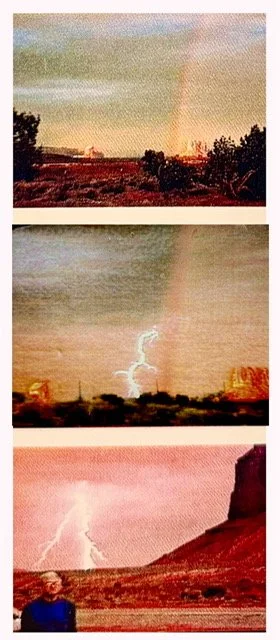
Monument Valley video stills, 1991.
On the return trip, nerves frayed. We were exhausted and fed up with each other. Rarely did the four of us sleep in the RV together but one night we did, even though we were barely communicating. Around 4am I heard David rustling and asked what was up.
“I’m going to see the sunrise in Monument Valley.”
“Can I come?”
That morning may well be the most memorable of my life. Just David and I, two tiny beings alone in this indescribably enormous space. The sun was rising, a thunderstorm in the distance soon passed over us, a rainbow appeared and we saw a bolt of lightning crack through its middle. I shot some video but no reproduction could come remotely close to capturing the grandeur. We were both awestruck. It was an unforgettably spiritual moment.
There are hundreds of hours of Hi-8 video in the Hockney archives and not just of the operas. We taped everything - dinner parties, the dogs at the beach, and David’s fabulous ‘Wagner Drive’ through the Santa Monica Mountains. I managed to save a few hours for myself. Hi-8 now appears very Lo-Res, in grainy, fading, bleeding colors. Still, I enjoy occasionally watching them. Featured here are 3 screenshots, unimpressive as images go, but like Proust biting into a stale madeleine, they can instantly conjure vivid memories. Such is the power of reproduction.
SHOWTIME
In January 1992, Turandot opened in Chicago. Although I had spent two years working on the opera, immersed in every aspect, I sat spellbound in the theater with the rest of the audience. For the finale, as the orchestra steadily builds to the last deafening note, David projected incrementally intensifying red light on an already blood red set. The entire opera house seemed to be inside of a throbbing heart. Then everything went black. The sold out, full house rose to its feet for a long thunderous ovation.
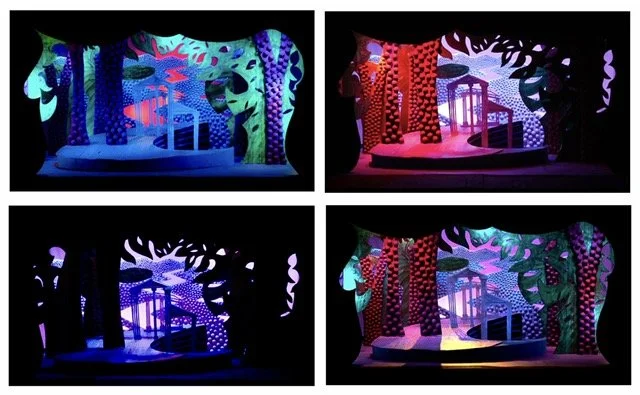
Die Frau onhe Schatten studio set models with lighting changes, 1992.
Back in LA, with barely time to rest, work continued on the next opera, Richard Strauss’ Die Frau onhe Schatten (The Woman without a Shadow) for The Royal Opera at Covent Garden. David’s seasoned friend John Cox came onboard to direct. Strauss is more difficult and less accessible music than Puccini but glorious after multiple listenings. David knew he could enhance the score by emphasizing the lighting to heighten and progress the story. The sets were constructed to maximize shadows—cut out shapes, varying textures, and geometric objects repeating and altering in size. What the audience saw was pure abstraction and clear representation intertwined. A forest, a river, a dyer’s workshop. A tour de force. Hockney had given new meaning to the term “Light Opera.”
Die Frau premiered at the Royal Opera in London in November 1992. Another triumph. Sadly, because of his deteriorating hearing, it was the last opera Hockney would ever design. But the operas had allowed him to work in sculpture, performance, and installation - fields of artistic endeavor he is not usually associated with.
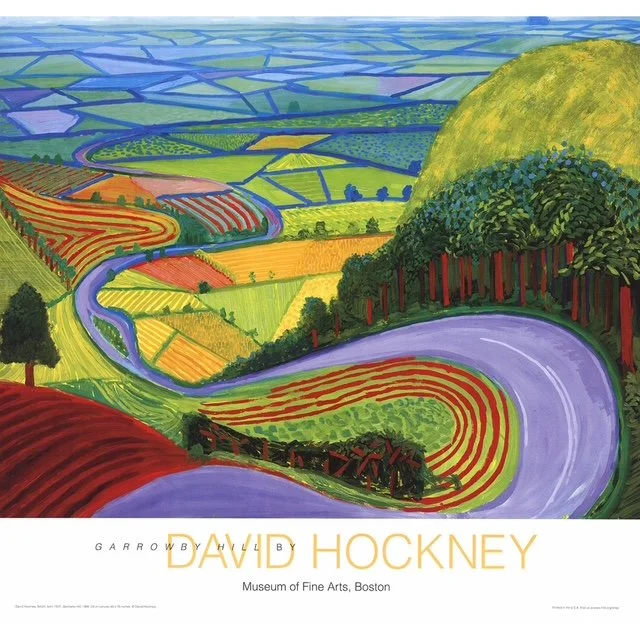
Museum of Fine Arts, Boston poster. Image: Garrowby Hill, 1998.
LIFE GOES ON
Hockney had now reached his mid-career, firing on both cylinders. I however was having a mid-life crisis. A bit of breakdown. I had been feeling in over my head for some time and returned to Boston to get my life on track. The massive model in the studio was dismantled and Hockney retreated to painting. Eventually I found a calm, enjoyable gig as a guard at the Museum of Fine Arts.
David and I stayed connected via phone, fax, and post. I would visit him in Hollywood and Malibu or travel to his latest openings in LA, New York, and London. His prodigious output never abated but his life reverted to a more private pursuit. No longer his employee, our friendship strengthened.
Gradually David’s paintings drifted away from the curving abstractions of the opera era to more figurative styles in landscape, still life, and portraiture. He once again took up the conventional printmaking of lithography and etching. However, from here on, the vanishing point was being banished, replaced by multiple perspectives. In particular, he fixated on the idea of reverse perspective where the viewer becomes the vanishing point. Unlike a camera which has only one eye, we see with two. David would discuss this with anyone who would listen and I was all ears.
With galleries and museum shows in the US, Europe, Japan, and Australia, Hockney’s popularity was now global. But it was Yorkshire, his homeland, that was summoning him. In Bradford, his birthplace, his mother Laura was now in her late 90s. His brother Paul, once the mayor, had a growing family with children and grandkids. His sister Margaret lived 90 minutes east in Bridlington, a charming coastal town which seemed frozen in the Victorian era. His itinerant brother John was close by. The Hockney clan is a tight, loving bunch. David had never lost touch with them since leaving for the Royal College of London decades before but only returned intermittently for short visits. That was about to change.
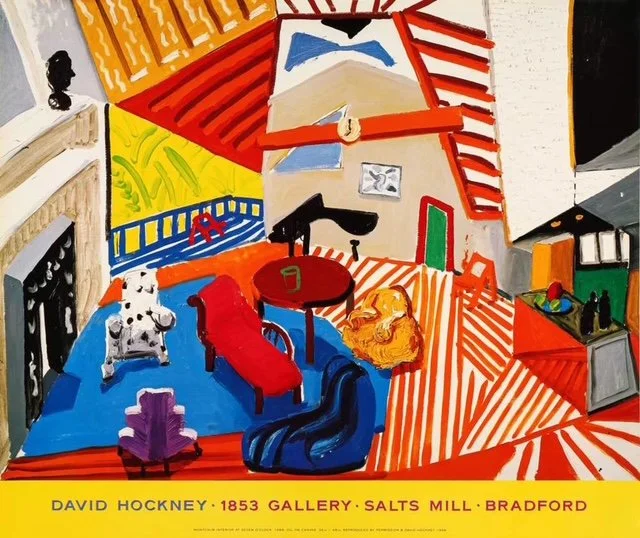
Salts Mill poster image: Montcalm Interior at Seven O’Clock, 1998.
GOING HOME
Jonathan Silver and David, apart in age by 12 years, both went to Bradford Grammar School. As a student, Silver had asked Hockney to draw a cover for a school magazine he was editing. David did. He liked this cheeky persistent lad, and they stayed connected through the years. In the late 80s, Jonathan visited David in LA with another request. He had purchased an enormous building in Bradford, Salts Mill, which was formerly the region’s center of industry but now abandoned. He wanted to revitalize it with offices, shops, and restaurants. Would David agree to show his work there to drum up some publicity? Once again, David agreed.
Jonathan was a kind, energetic, and exceptional man. Razor sharp, quick with a smile, always a twinkle in his eye, he could sell ice cubes to Eskimos. David recognized a kindred spirit who could dream big and make it happen. When he heard in 1997 that Jonathan was dying of cancer, Hockney was devastated.
At the same time, David’s mum transferred into a care facility in Bridlington. His trips home became longer and more frequent. Driving through Yorkshire, he began to view the agricultural landscape, the gently rolling hills and dales, with fresh eyes. “Paint East Yorkshire,” Jonathan urged him. Working in a tiny studio in Margaret’s attic, David did just that. When he returned to Hollywood, he told friends he had been making pictures “on location.”
Jonathan died at the youthful age of 47 with so much left to do. In LA, David painted his native ground from memory. Jonathan’s wife Maggie along with his brother Robin carried on his vision. Now overseen by their daughter Zoë Silver, Salts Mill remains a thriving hub and a top UK tourist destination, just as Jonathan had envisioned it. They continue to have frequent shows of Hockney’s work and do brisk sales of his reproductions.

National Museum of Art, Smithsonian poster. Image: A Bigger Grand Canyon, 1998.
HOCKNEY IN BOSTON
“I’m a space freak,” Hockney has often remarked, and there are few spaces as remarkable as the Grand Canyon. David felt it was a sacred place. He could sit for hours, stare into the gorge, and watch a visual symphony of sun and shadows play across the shimmering layers of sedimentary rocks descending a mile deep. Throughout 1997, he revisited the canyon to try to depict its epic scale. In the '80s he did this using photo collage. Now he would make drawings and use them to paint from memory.
Meanwhile, at the MFA, I made the acquaintance of curator Barbara Shapiro, a huge Hockney fan who had caught wind of my friendship with David. She spoke with the new museum director, Malcolm Rogers, previously from the National Portrait Gallery in London. Things moved quickly and on April 24, 1998, the exhibition New Paintings by David Hockney opened at the MFA. Featuring large Yorkshire landscapes and some truly grand Grand Canyons, it was an immensely popular show. I know this because I stood in the gallery with my clicker keeping track of how many visitors came through and noting how long they lingered. For me it was amusing to think I had been in these very places with David, then watched him paint them, and now I was standing guard over the finished work.
“It reminds me of London,” David said when he came to Boston for the opening and we walked from the Public Gardens to the museum. Eight years later he would return with a bigger exhibition.
LOST KNOWLEDGE
In Spring of 1999, David saw an exhibition at The National Gallery in London, Portraits by Ingres, and had an epiphany. Why were they unusually small? Why did the faces appear “photographic,” yet the clothing looked freely traced? Had some optical device been used to make these stunning likenesses? The museum wall text and catalogue made no mention of it nor had any earlier art historian.

Camera lucida portraits: Ian McKellen, Barbara Isenberg, John Cox, 1999.
On March 15, I received my first fax from “DH in the Hills.” David had purchased a camera lucida (a small prism on a stick) and was utilizing it to draw daily portraits. He was certain Ingres had used one too. Soon I was getting a flood of faxes - pages of research along with dozens of new portraits.
Hockney was writing a book, in his own hand, on lined paper, at last putting his theories on optics and perspective into words. He knew he was right. Art history had overlooked something of profound significance, artists had been using mirrors, lenses, and cameras for centuries! Why had the “experts” missed this? Hockney pursued this scholarly obsession with a vengeance.
I kept his fax missives in what is now a big, bulging, blue binder. The writing seemed to flow from his mind in a barely controllable torrent, as though a dam holding back his speculations had finally burst. He was on a mission and made one convincing argument after the next. The proof was in the paintings themselves. David kept adding art books to his already impressive library, scouring the images for clues.
Certainly, I was not the only one getting the faxes. A growing number of friends, artists and scholars joined in the conversation. I flew out to Hollywood to see for myself and was, as ever, astonished. Using hundreds of reproductions copied from books, he had begun to assemble a chronological history of western art, stretching the length of his studio wall. He wished to pinpoint when the camera influence in depiction began. It was around 1420! More on this later in Part 3.
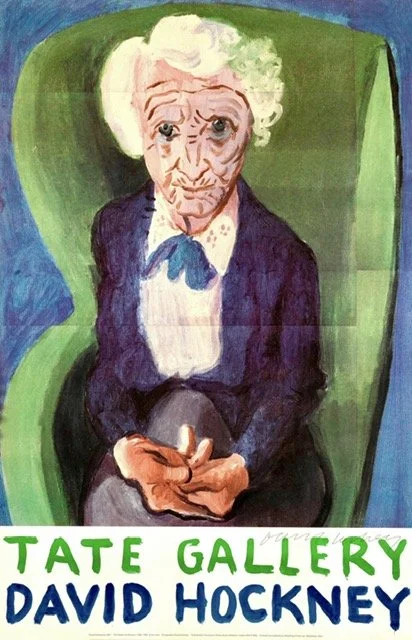
Tate Gallery poster. Image: My Mother (Bridlington 1988).
THE NEW MILLENIUM
On May 11, 1999, David’s mother Laura died at age 99. A pious woman of great strength and endurance, she had witnessed the entire 20th century. A week earlier David left for Bridlington to be by her side when she passed. In David’s many portraits of his mum his deep love is visible. Pouring himself into his work was always how he dealt with grief. He brought his camera lucida to draw family and friends. In London after the funeral, David continued drawing and discussing his discoveries. By now, he had an expanding cadre of supporters. Highly respected historians Martin Kemp, John Spike and Martin Gayford excitedly encouraged him to carry on. Artists such as Lucien Freud, R.B. Kitaj, and Francesco Clemente equally agreed. Hockney drew lucida portraits of each of them. As Lucien commented, “You may not be an art historian David, but you’re a great art detective.”
I spent the 1999 Christmas holidays in Bridlington with David, merrily welcomed by the Hockney family. After Boxing Day, we went to London. We squeezed in a quick trip to Paris, raced through the City of Love, saw lots of art, smoked at the cafes, ate fine cuisine, and walked for miles. I could barely keep up with him.
After that whirlwind tour we were back in London for New Years Eve. Although neither of us are keen on crowds, David and I went down to the River Thames, mingled with the masses, watched the fireworks, and waited for the river to burst into flames at midnight as was promised. It never happened but no one cared. It was time to party. Happy New Year! 2000!
At that historically liminal moment in human history, Hockney was restless, eager to be in his LA studio, and on to the 21st Century.
*David Hockney by David Hockney will be reissued later this year in full color, for its 50th anniversary.
Bing McGilvray is a feature writer and illustrator for Cape Ann COSMOS. As the creator of Cosmic Bear Comix and BingOgrams he has wandered far and wide, to UMass (BA ‘76), UCLA (MFA ‘86), here, there and beyond. Used to be he was everywhere (like Cosmic Bear) but Bing now happily resides in Gloucester MA and has little desire to “go over the bridge.”
Click here to read more features by Bing McGilvray, including his series on Hockney Reproduction(s).
To receive future feature articles and our curated events list, subscribe to Cape Ann Cosmos, publishing alternate Wednesdays and FREE.


On the morning of June 12, barely awake, sitting with my coffee, I opened my emails as I always do. The first one began: “The celebrated British artist David Hockney, …