
400 Trees Takes Root
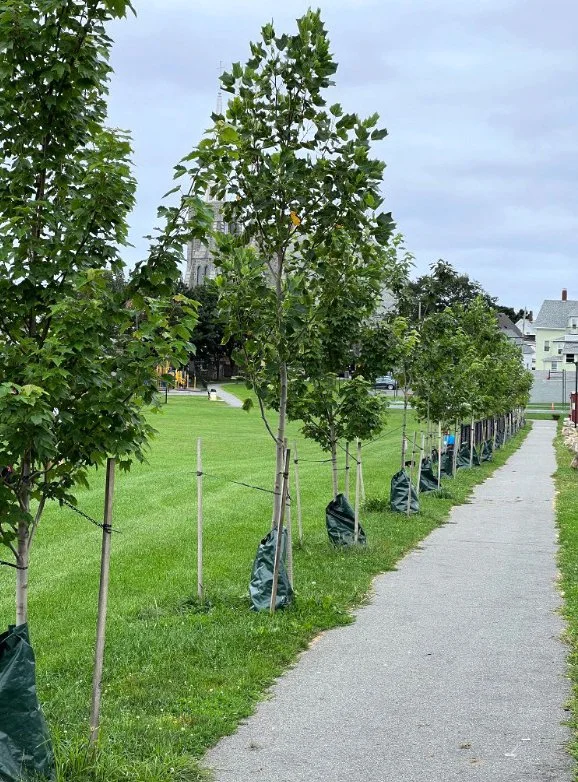
Trees planted at Burnham Field as part of the Gloucester 400+ celebration.
April 1, 2026
By Victoria Fortune
“The planting of a tree … is a gift … to posterity.”
— George Orwell, A Good Word for the Vicar of Bray (1946)
It started out as an environmentally clever way to contribute to Gloucester’s 400+ birthday celebration: Plant 400 trees, inspire community, then call it a day. Instead, 400 Trees took root.
“We thought planting 400 trees would be a lasting, appropriate way to celebrate Gloucester’s 400th birthday that also would provide shade, capture CO2 and beautify the city. A simple, yet bold project with a clear ending when we planted that last tree,” said Peter Lawrence, Executive Director, Biomimicry New England (BNE) and founder of 400 Trees. “But as we got into it, it became very clear that we could do a lot more and that the community was eager to engage. We have grown so much since then. It’s been quite amazing.”
THE ORIGINS OF 400 TREES
The initial 2023–2024 effort was a collaboration of four organizations, each committed to purchasing and planting trees. BNE/400 Trees original commitment to 100 trees was matched by Cape Ann Elms, which agreed to plant 100 elms in Gloucester; The 100Trees Project agreed to plant 20 trees in Burnham Field; and the Gloucester Mayor and Dept. of Public Works then agreed to contribute the remainder to achieve 400 trees.
These plantings included white and red oaks, honey locust, American Hophornbeam and others, now growing on residential properties along sidewalks, at schools, playgrounds, parks, cemeteries. Lawrence says the trees will ultimately reduce the temperature. They will also help mitigate climate change by sequestering CO2 and contribute to a healthy ecosystem. Oak trees are a vital keystone species that supports more biodiversity than any other tree species in North America, providing essential food and habitat to hundreds of types of birds as well as mammals and insects.
A GROWING FOOTPRINT
Building on that early momentum, Lawrence enlisted others and solidified 400 Trees into a permanent program of Biomimicry of New England, the Gloucester based non-profit organization with the mission to establish nature and natural systems as an important resource for education and innovation in New England. Early sponsorship support was received from the Gloucester 400+ Committee, Cape Ann Savings Bank, the Brace Cove Foundation, WT Rich company, Jane Deering Gallery, and others.
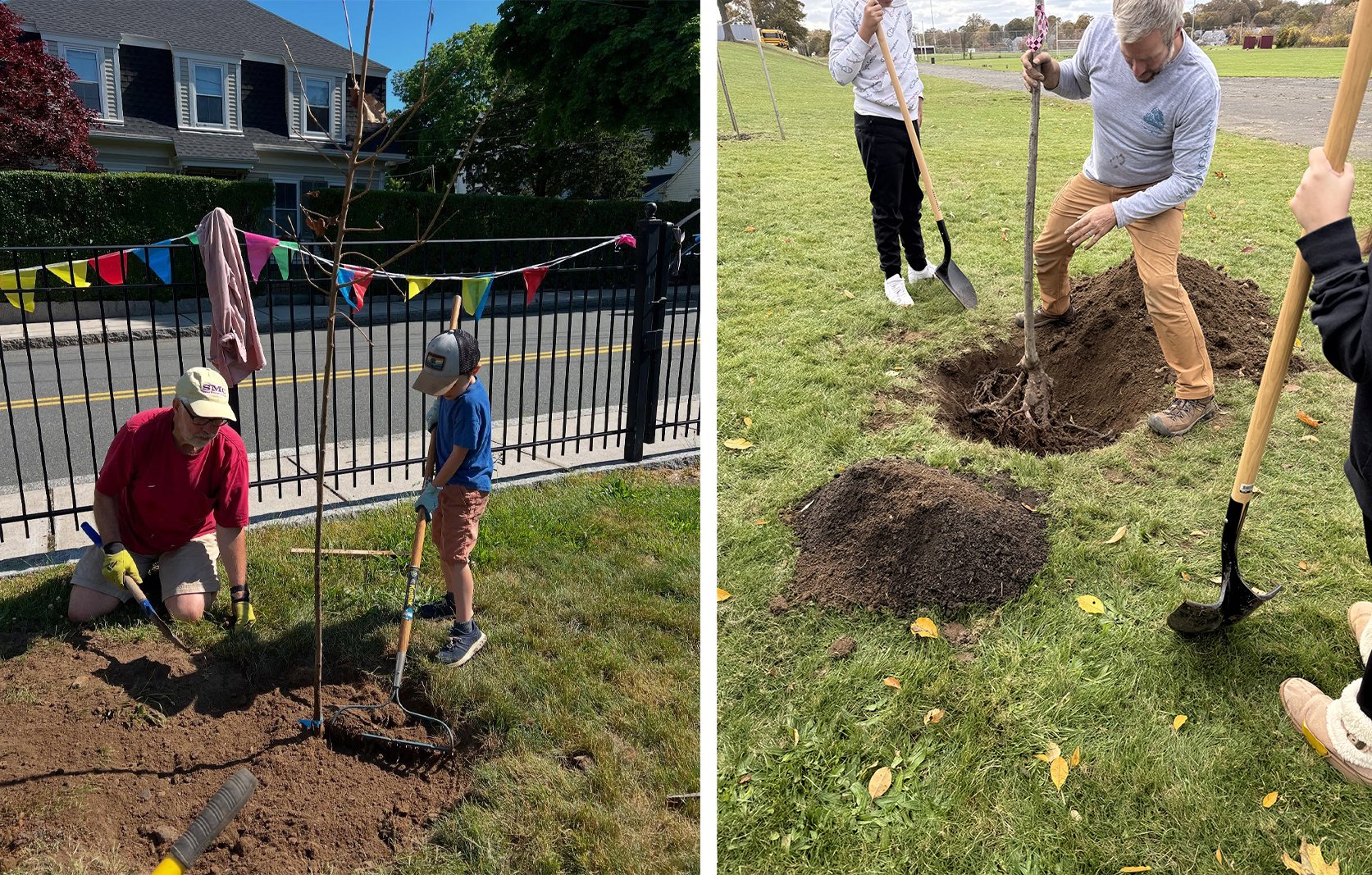
Left: Volunteers plant at tree at Rebecca’s Playground in Lanesville. Right: Arborist Jack Montgomery demonstrates for O’Maley students how to plant a tree.
In 2025, tree planting evolved to plant larger trees — 2 to 2 ½-inch balled and burlaped (B&B) trees — within the city’s heat islands and neighborhoods that bear a disproportionate burden of environmental hazards. This began with a grant from the Massachusetts Department of Conservation and Recreation (DCR) to plant 18 trees around City Hall, Sawyer Free Library, and the Central Grammar elderly residential building — a hot spot where temperatures can be 10-13% warmer than other areas of the city with trees.
Today, 400 Trees is continuing to plant larger, native and resilient trees in the heart of Gloucester to reduce the urban heat island effect, enhance public spaces, and demonstrate how trees contribute to climate resilience and neighborhood vitality.
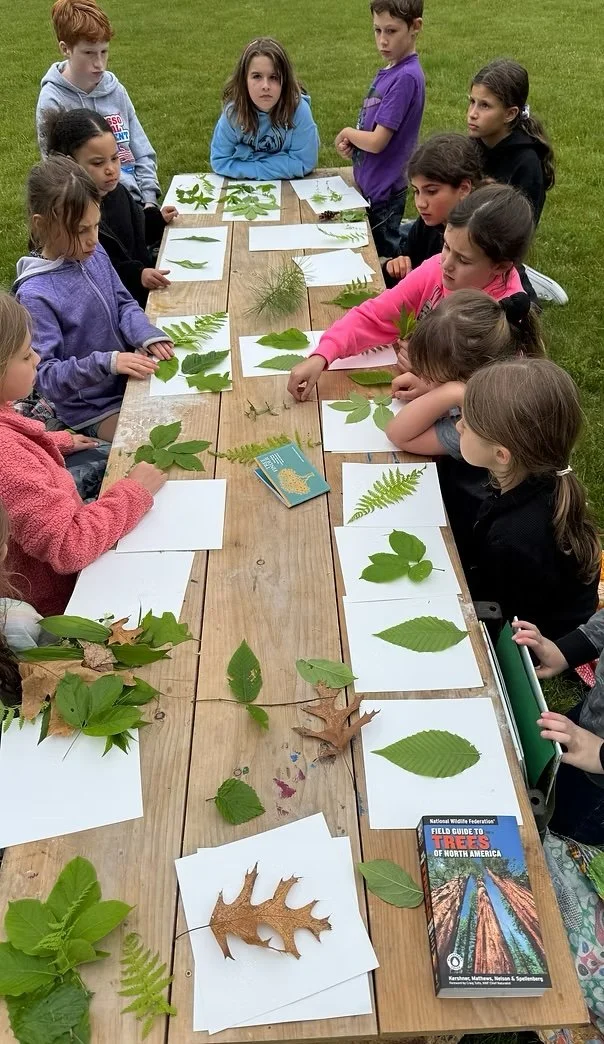
Students at West Parish learn about different types of leaves in Dirt Club.
The nonprofit has recently gotten a big boost from grants, including a $97k “Cooling Corridors Grant” from the Mass. Executive Office of Energy and Environmental Affairs. This Grant will support professionally planting 50 trees this spring in Gloucester's center city hotspots and to hire the help needed to maintain them for the next two years.
EXPANDING THE MISSION
The other component of 400 Trees — educating youth and adults about the importance of trees — took longer to get established. Education is a key to nurturing the next generation of environmental stewards to care for the environment around them, and to promote a healthier, more resilient ecosystem. In an early collaboration with the Gloucester Health Department, teams of youth documented some of the oldest trees in Gloucester. At the Cape Ann YMCA’s Camp Spindrift, groups of campers planted some native oak trees. 400 Trees’ work with Gloucester schools began with the planting of 18 trees at the Plum Cove Elementary School.
The education component expanded considerably when the YMCA Executive Director Erina McWilliam-Lopez invited 400 Trees to create a club that would engage students during the first hour of the Y’s after-school program at Cape Ann elementary schools, and Dirt Club was born. 400 Trees has since expanded its education mission to include working with local schools to support the development of curriculum that utilizes outdoor space and to educate the community about the importance of planting trees via lectures and workshops.
400 TREES EDUCATIONAL INITIATIVES
In partnership with the Cape Ann YMCA, the Dirt Club is designed to get students outside and into the woods. The program began in the Fall of 2024 at two elementary schools in Gloucester—Plum Cove and Beeman. In 2025 West Parish and Rockport Elementary Schools were added. Each week, kids literally get their hands in the dirt and learn about the ecosystem around their school and the various life it supports. Led by volunteers and YMCA staff, they explore the woods, get a lesson on what’s around them, and create nature-based crafts.
The Native Tree Grove at O’Maley Innovation Middle School serves as a living outdoor classroom. This began in the fall of 2024 with the planting of four white and red oak trees by students. Last November, under the direction of 400 Trees arborist Jack Montgomery, four classes of students each planted an additional oak. The grove will provide a learning location where students can explore ecology, phenology, and the life cycles of native trees through place-based learning. Additional native trees, including Paper birch and pitch pine will next be planted by students. Growing between the hockey rink and playing field this grove will support educational exposure to nature for all students in the school.
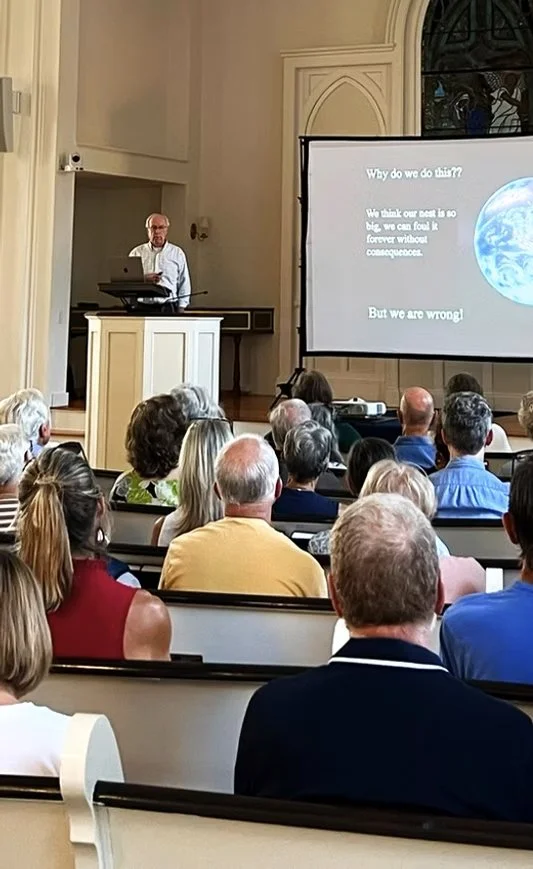
Environmentalist and author Douglas Tallamy gives a Tree Talk at Annisquam Village Church.
In addition to planting new trees, the organization is focused on caring for trees that are already there through the Tree Stewardship Program. This active learning program will engage youth through Gloucester Schools, the Cape Ann YMCA, and the Gloucester Health Department to care for, monitor, and document trees throughout the city, building skills, responsibility, and long-term connections to urban forestry.
BRANCHING OUT TO THE COMMUNITY
Hosted in the community room of the new Sawyer Free Library in Gloucester, Tree Talks bring local and regional experts together to share knowledge about native trees, plants, and Gloucester’s ecosystem through programs for both adults and youth.
This program was launched in September 2025 to a sellout crowd at the Annisquam Village Church. Renowned environmentalist Douglas Tallamy gave the keynote Tree Talk on the power of native plants. The second presentation was by local native plant expert Cheryl Rafuse. Arborist Jack Montgomery will speak on April 2 at the Sawyer Free Library about tree health and how to support the trees around us. And the landscape architect who designed the native landscape at the Sawyer Free Library, Lisa Giersbach, will speak about this first native landscape at a Gloucester public building on May 14.
Support from donors and volunteers will enable 400 Trees to continue growing their education and stewardship programs. For more information, please go to 400treesma.org.
Victoria Fortune is a writer and the Education Director for 400 Trees. She holds an M.Ed from Harvard University and an M.F.A from Salve Regina University. She has worked as a classroom teacher and an editor in educational publishing. Her writing focuses on nature and mankind’s relationship with the environment. Her work has appeared in The Sun, The Ilanot Review, and CRAFT, and she is co-founder of the blog actsofrevision.com.
To receive future feature articles and our curated events list, subscribe to Cape Ann Cosmos, publishing alternate Wednesdays and FREE.