Rafe’s Chasm and Antelope Canyon: Two Corners of the Continent
© Paul Erickson
June 24, 2026
From Cape Ann’s famous quarries to the Grand Canyon—holes, cracks, crevices, fissures, gorges, slot canyons, ravines, and chasms fascinate us.
Thank you Merriam-Webster Thesaurus.
One of our local geological attractions in the Cape Ann region of topographical anomalies is Rafe’s Chasm (once known as Rafe’s Crack). Located on the shores of Magnolia Village, just outside Gloucester Harbor, this large crevice is a vestige of an ancient basalt dike. The dike formed millions of years ago when molten basalt magma blasted its way into a nearly vertical, pre-existing fissure in Cape Ann granite. Because basalt is more prone to erosion than granite, over vast periods of time, the eroding basalt left an open chasm sandwiched within its more durable surroundings.*
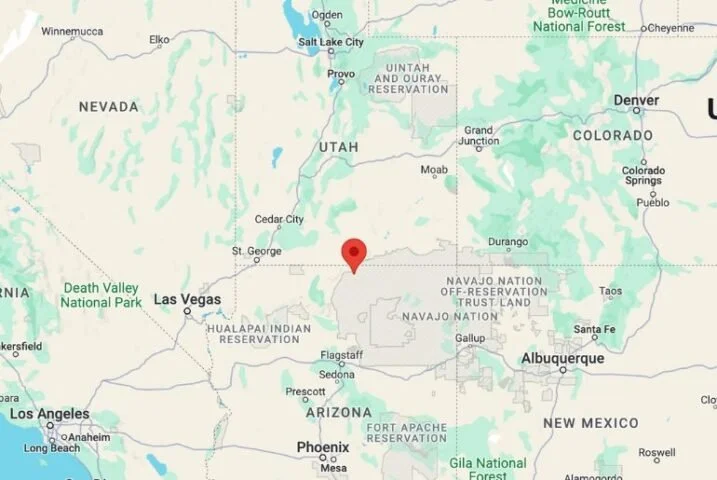
Earlier this year, while Rafe’s Chasm was battered by icy nor’easters, a different kind of crack in the earth’s crust attracted my wife Susan and me to a place located roughly 2,500 miles southwest of Cape Ann. There, in northern Arizona, I set out to photograph, for COSMOS, what I view as the eighth wonder of the world.
THE SLOT CANYON
Arriving on a hard-packed, high desert landscape in the Navajo (preferably Diné) Nation, near Page, Arizona, and the Glen Canyon Dam, we gazed out at a hard-packed, reddish, Mars-like landscape stretching to the horizon. Our particular destination was a tour of Antelope Canyon, likely misnamed by English-speaking migrants who incorrectly confused North American pronghorns with antelopes. True antelopes are native to Africa and Asia, not North America.
Mysteriously, as we awaited our tour guide at the entrance to the canyon, a human head arose from the desert floor. Then another, and another, as a tour group climbed out of a crack in the sandstone. They were winding their way through a narrow, yet easily hike-able, slot canyon called Lower Antelope Canyon. I recalled a scene from the 1951 movie Superman and the Mole People when Munchkin-like humanoids emerged from their deep, subterranean realm.
Now it was our turn to descend into the colorful, sunlit canyon.
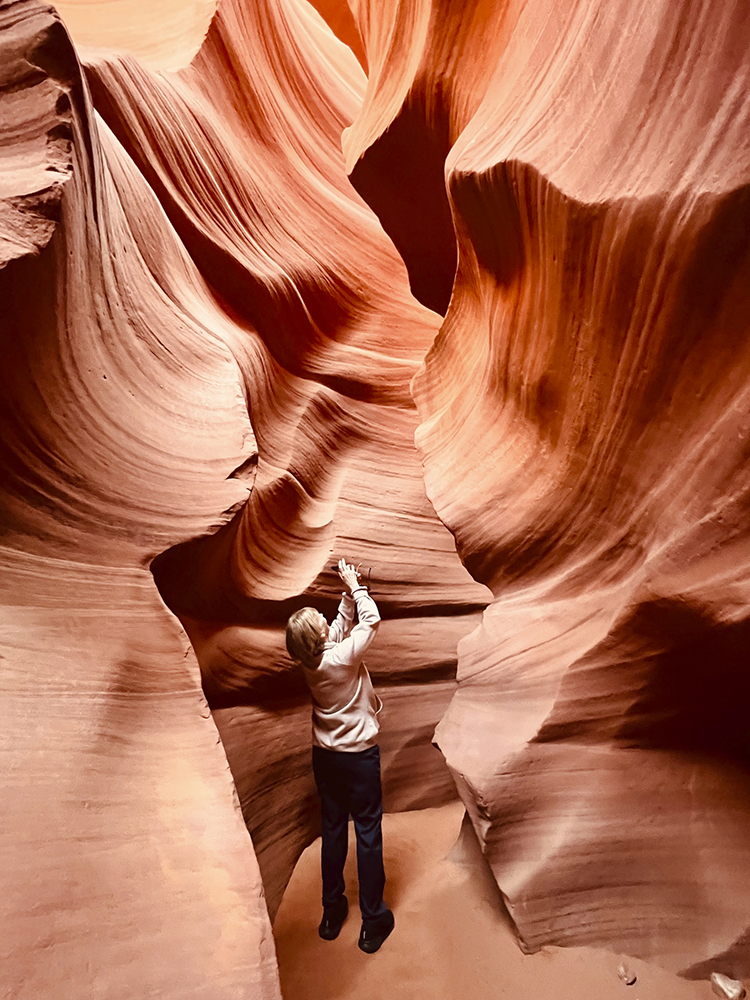
We were met by a friendly informative Dené guide. We learned that Dené means “the people.” In addition to Navajos, the name encompasses a wider group of Athabaskan language speakers, including the Apache. Thus led, Susan and I, along with a small group of other tourists, descended a wide steel staircase to the sandy canyon floor, which at its deepest point is 120 below ground. There, astonished by our surroundings, we found ourselves spellbound among layers and swirls of sandstone resembling butterscotch taffy. Flash floods, rocks, and sandblasting winds have sculpted the smooth canyon walls for some 190 million years.
Tragically, in 1997, 11 visitors died when a flash flood generated by a distant thunderstorm gushed through Lower Antelope Canyon. Subsequently, the Navajo (Dené) Nation closed the canyon for about a year. During that time, intruders vandalized this geological and cultural treasure. As a result, the Navajo people eventually opened the canyon to protect it and provide enhanced safety precautions. Today, no one may enter the Upper or Lower Antelope canyons without an indigenous guide and advance reservations.
My brief travel log basically ends here—the accompanying photos best describe the experience.
*Warning if visiting Rafe’s Chasm in Magnolia: Please pay attention to the caution signs near the chasm. The attraction is located on private property. Falls and fatalities have occurred here. And given the irregular, steep terrain, it’s not a good place to walk a dog.
PAUL ERICKSON
Science Editor
Paul trained in life sciences at Bates College and is a natural history writer, diver, and photographer. He worked at the New England Aquarium for 26 years and served as an on-camera correspondent for many programs, including ABC’s Good Morning America and WBZ-TV’s Eyewitness News, Evening Magazine. He has also worked as an educator at the Glen Urquhart School and aboard the Salem-based Sea Shuttle Endeavour. Paul has photographed underwater habitats in the Red Sea, Solomon Islands, Fiji, Belize, the Philippines, New England and Loch Ness, Scotland. His latest books, published by Tilbury House, are Don’t Mess with Me: The Strange Lives of Venomous Sea Creatures and The Pier at the End of the World. Paul lives in Ipswich.
All photos © 2025 by Paul and Susan Erickson, except for historic postcard, which is in the public domain.
To receive future feature articles and our curated events list, subscribe to Cape Ann Cosmos, publishing alternate Wednesdays and FREE.