
Seasonal Poems by Miriam Sanders & K Prevallet
Reproduced here in conjunction with a spontaneous reading and book signing with Jim Dunn, K Prevallet, and Miriam Sanders (by proxy).
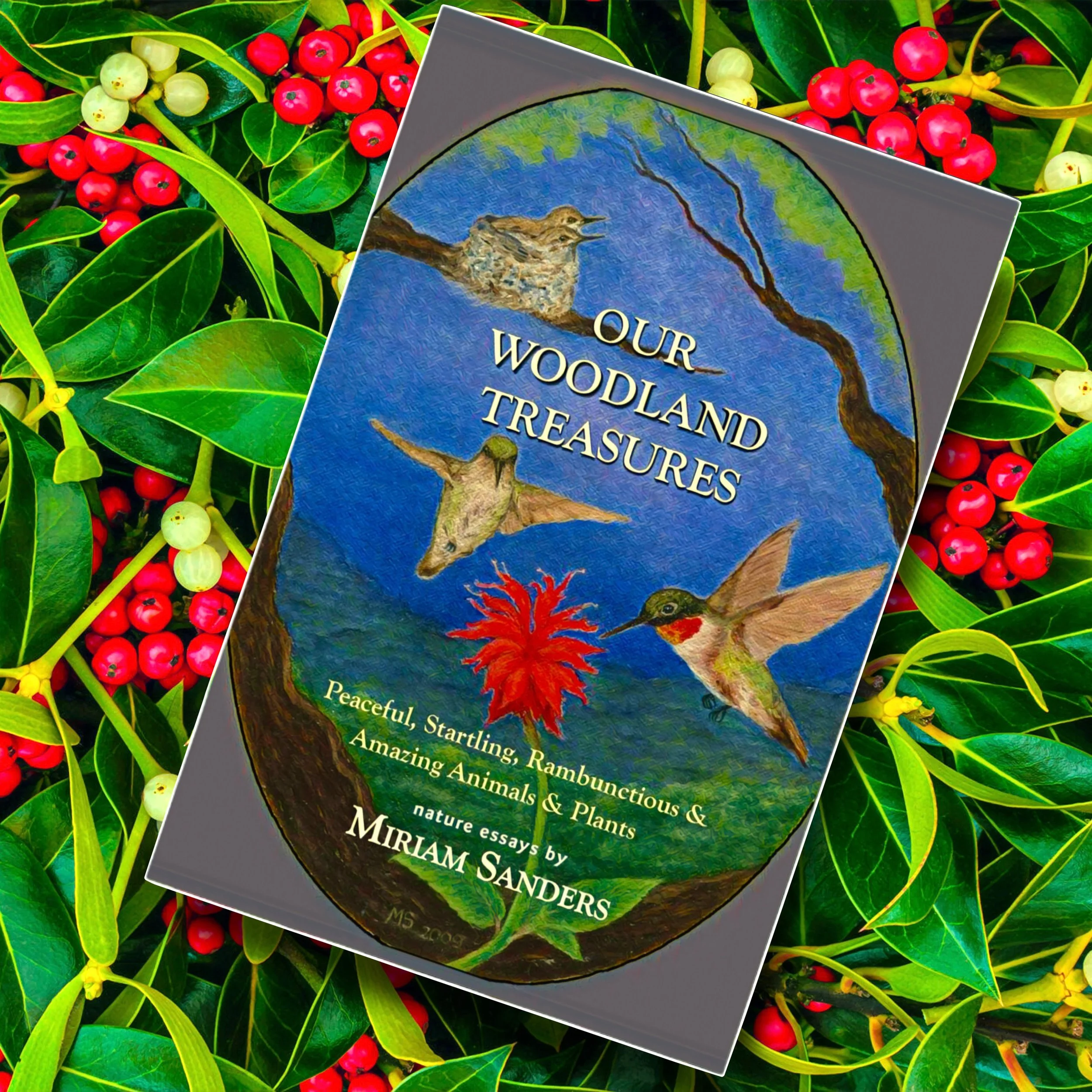
Our Woodland Treasures is available at COSMOS Gallery, Dogtown Books, and various online outlets.
“The Mysterious Mistletoe”
Published in Our Woodland Treasures
By Miriam Sanders
Reproduced with permission of the author
This is the time of year when, should a young man notice a girl standing beneath a sprig of mistletoe hanging over a doorway, he would be permitted to steal a kiss. Some say,"One kiss for each berry on the plant!"
In ancient times, according to the Roman scholar and historian Pliny, the Druids revered the mistletoe. They held their sacred rites in oak groves, and whatever grew upon the oak, such as the mistletoe, was thought to be a divine gift. When a mistletoe plant was discovered, a priest, clad in a white robe, cut it off the branch with a golden knife. Two white bulls were then sacrificed on this spot. The mistletoe was thought to have magical properties and healing powers. It was taken in a drink as a cure for sterility and an antidote for poisons, curiously, since mistletoe itself may be fatally poisonous!
In Scandinavian mythology, Balder, the sun god, was slain by the blind god Hod, with a branch of mistletoe. Balder, son of Odin and the goddess Frigg, was radiantly beautiful and greatly loved. Frigg elicited a promise from every being and thing on earth, except the mistletoe, not to harm Balder. She had, unfortunately, deemed the mistletoe too young to take an oath!
The mistletoe is a partially parasitic plant. Although it has leathery, green leaves with chlorophyll that manufacture food in the presence of sunlight, it depends on a host plant to provide it with water and minerals. The mistletoe accomplishes this by utilizing small modified roots known as haustoria that penetrate the host.
The mistletoe has inconspicuous, yellowish flowers and plump, round, ripe berries whose pulp is transparent and viscous. The pulp is so sticky, in fact, that birdlime (a substance smeared on branches to catch birds upon alighting) was sometimes made from it.
The mistletoe is parasitic on a wide variety of trees, both evergreen and deciduous. Among these are apple, poplar, willow, oak, maple and larch. Seed dispersal occurs in this manner: sticky seeds adhere to a bird's beak when it eats mistletoe berries. When it flies to another tree and wipes its beak on a branch to clean it, the seeds cling to the bark and are "planted". Mistletoe grows slowly and its life span is usually determined by that of the host plant.
In New Zealand, there are gigantic mistletoes that can grow to a height and width of nine feet and live for a century! At Christmas, they produce large, scarlet blooms, tightly closed. Only certain native birds can open the buds and pollinate the flowers, but their numbers are being decimated by non-native animals, such as rats, ferrets and cats. A native bee can also open the buds, but only the birds eat the fruit and disperse the seeds. Therefore, scientists are greatly concerned about the future of these interesting plants.

Miriam Sanders is a naturalist, writer, painter, illustrator, and environmentalist who has lived over 45 years in Woodstock NY with her husband Edward. She is the author of Marie in the Moonlight, about the nighttime adventures of a mouse on Meads Meadow Mountain in Woodstock.
For over 10 years Miriam helped produce The Woodstock Journal, a weekly Public Access television program in her beloved community.
The Mysterious Mistletoe is one of 80 brief nature essays in Our Woodland Treasures, each one full of acute observation, factual history, and mythic legend. Miriam also drew the many charming illustrations. The essays were originally published inThe Woodstock Journal newspaper from 1995 – 2003.
Our Woodland Treasures is available at COSMOS Gallery, Dogtown Books, and various online outlets.

A Varied and Tender Multiplicity is available at COSMOS Gallery, Dogtown Books, and various online outlets.
“Pinaceae”
Published in A Varied and Tender Multiplicity
By K Prevallet
Reproduced with permission of the author
Of the fibronchi sequence & fractal pattern that forms the organizing consciousness of nature & life itself; in this way is kin to sunflower, lichen, and rose. Cosmic portal when hung as wreath on door for winter solstice to welcome the return of light. Concentrates psychic work and when drawn as a circle in the air stimulates defensive energies and breaks hexes. White pine bark (pinus strobus) expectorates mucus and fights infections especially chronic bronchitis; pine gum for wound healing; pine pollen to strengthen muscles and tendons, pinecone jam on morning toast for stability and strength. Ballads exhault knowledge of a child lost in the pines, exposed to dangers beyond her understanding.
tune chair to pitchforks
drop water into mind at play
digitally remaster sandbox to fit only one way
look out while wondering as dog barks let me in
warm tea as wandering hem skirts kale crumbs
avoid withstanding another's outside;
withstanding anchor to self
drop tantrums into heart center
dissipate wandering eardrums
make love to candlelight avoid wax
when in mind of winter be like pine

K Prevallet is a poet and scholar living in Gloucester, MA where she is the residency administrator of the T.S. Eliot House. K has published seven collections of poetry, including most recently, A Varied and Tender Multiplicity: a materia medica of plants, poems, and spells (Station Hill Press). Her poems, essays, and reviews have appeared in many publications including The New Republic, The Harvard Review, The Boston Review, and Peripheries. Recent work appears in The Body in Language (Counterpath Press) and Other Influences: An Untold History of Feminist Avant-Garde Poetry(MIT Press.) For more about her work visit are.na/k-prevallet/